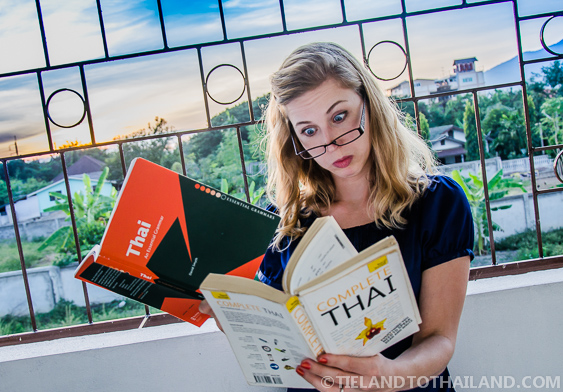
As expats in Thailand, Chris and I understand the long-term benefits and practicality of learning the Thai language. We have plans to enroll in a Thai language program in Chiang Mai in the coming months. Meanwhile, I’ve been self-teaching myself how to speak and read beginner Thai using several different methods. If you’re thinking about staying in Thailand for awhile and want to teach yourself Thai, check out my recommendations.
Teach Yourself to Speak Thai

Pimsleur Thai Phase 1: Learn to Speak and Understand Thai
The best way to teach yourself conversational Thai is to do what babies do (but with Pimsleur’s Thai): listen and repeat, again and again. The audiobook (CD or downloadable audio files with booklet) provides roughly fifteen hours of conversation from which you can teach yourself Thai by listening to and repeating the dialogue.
Why I Like Pimsleur Thai
I like that Pimsleur Thai introduces new words or phrases one at a time, most of which I learned through context. This method helped me retain the new vocabulary better than traditional word drills. I also like that the conversation length and complexity gradually increase during each topic. During every conversation, small sections were repeated several times, which gave me time to absorb everything. After listening to Pimsleur’s Thai, I was more comfortable with sentence structure, repeating the proper tones, and understanding common topics, such as ordering food from a restaurant, asking how much something costs, and telling time in Thai.
Get your copy of Pimsleur’s Thai (audio recording + booklet)
Teach Yourself to Read and Write Thai

Complete Thai by David Smyth
If you want to take it a step further and teach yourself Thai characters in order to read and write, Complete Thai is a wonderful book-CD combo to use. Within each chapter, new vocabulary and short conversations are provided. This helps you reaffirm the Thai alphabet and strengthen your reading skills. The optional CDs also provide extra listening material.
Why I Like Complete Thai
This book is different from many beginner Thai books because it breaks down the Thai letters into small, easily digestible clusters within each chapter while gradually introducing the infamous five tone rules of the Thai language. This is better than being handed a long list of consonants (44!) and vowels (32!) with their respective sounds. Complete Thai also showed me the proper pen strokes needed to create each character. Because Thai is a very phonetic language, I was quickly on my way to reading basic Thai after learning the characters and tone rules.
Get your copy of Complete Thai (book + CD)
Teach Yourself Thai Grammar

Thai: An Essential Grammar by David Smyth
I’ll be honest. Thai: An Essential Grammar is a dry read, but the breadth of grammar topics covered within this book is quite extensive and provides an excellent foundation for the Thai language.

Why I Like Thai: An Essential Grammar
I think this book is a one-stop-shop for grammar rules. It does an excellent job of breaking down Thai grammar, which quickly diverges from English grammar beyond simple sentences. Direct translation only goes so far! I also like that it provides tons of vocabulary and small phrases among the grammar rule examples. If anything, this is a great book to use as a reference or supplement while you teach yourself Thai.
Get your copy of Thai: An Essential Grammar (book)
Yes, You Can Teach Yourself Thai
It takes dedication and determination to learn Thai outside of a traditional classroom setting, but it can be done. If you’re passionate about learning beginner Thai and want to teach yourself, I recommend any of the above books. I’ve been extremely happy with my progress using them. It’s exciting when you begin to understand and take part in basic Thai conversations.

Have you tried learning Thai yet? Would you rather stick to a class or is it worth it to try to teach yourself? Do you think it’s best to learn conversation or is it worth it to learn to read and write, too?
Really interesting post. Now it is also easier because you can use some apps.
Some great resources you listed there. Personally I always been a fan of Pimsleur. That’s how I learned Spanish. But I am eager to master the Thai language. I’ll check out the “Complete Thai” course.
Thanks for sharing!
Andy
Pimsleur is great if you really want to practice your listening and critical thinking skills (by figuring out new vocabulary from context rather than giving the definition outright). Thanks for commenting!
Complete Thai by David Smyth, I have that, and it’s excellent for the alphabet, as you have said.
It’s interesting that there are a lot of different books, each one teaches a different style or thing, out there.
For those still in the US, Half-Price books is a good resource, if you live near one. A few dollars goes a long way. You can pick up cultural guides, sometimes, also.
Thai language books aren’t as common as French, German, Italian, but they exist. There are also Compilations such as Southeast Asian Languages, which cover Thai, Burmese, Vietnamese, Malay, etc, all in one book. good for the border crossing traveler in Southeast Asia.
David Smyth rocks. I owe it all to him to be able to read and write Thai! I even like how he tells your which strokes/which order to draw each part of the letter. I feel formally trained :)
Hi, Chris and Angela: I just wanted to make a comment to this post regarding thai language study. I have been studying with a teacher named Miki. She is a very intelligent and talented teacher living in Bangkok. Miki and her older sister Tachaya are both Thai/English Teachers and they have developed their own thai language website: here is the link to it (pickup-thai.com). They also have developed an on-going Podcast series that has a two-tiered learning study focus: (1) for Beginner learners; and (2) for Intermediate to Advanced learners of Thai. The Podcast series is absolutely superb. I have not found anything else on the internet that is equal to it in depth and quality. It is presented via a combination of MP3 Audio Recordings and PDF Transcripts which contain both Thai Native Script – English Translation – and Transliteration. The lessons cover interesting natural conversations that occur in real life based on various situations. The narratives from the conversations are then reviewed with a Question and Answer series, a break-down review of the sentences comprising the total narrative, Vocabulary, a series of sentence examples that are similar to the sentences that were used in the narrative, and finally both Fast (i.e., native speaking speed) version of the audio conversation and Slow version to help the student pick up on the specific enunciation of the narratives. I just wanted to let both of you (Angela and Chris) know about this because I think both of you are trying to learn thai . . . as well as your readers about this really excellent resource. If you go to their website you will see the various prices for their Podcasts . . . they are very, very reasonably priced and you can buy just single Podcasts (one at a time), or packages of Podcasts, etc., etc. . . .they accommodate all student needs for on-going or intermittent purchases. Believe me. If you have even just a basic understanding of the thai language. This Podcast resource from two very talented and very nice young women will really enhance and accelerate your learning of a fascinating language. Again . .. their website is . . . http://pickup-thai.com . . . check it out.
LA-Trader (Brian)
Thanks, Brian, for sharing this. What a great resource for both us and our readers! We be sure to take a look at this tonight.
As always with languages, there are so many different ways of studying. I know a lot of people here in Bangkok that have signed up for expensive two or three months “intensive” beginner courses only to tell me that it’s still difficult and they are struggling. You don’t get to talk much in the classroom as well as direct feedback from the teacher and that’s so important for a tonal language like Thai.
As for myself, I just bought a textbook and studied all by myself during the first 6 months, and just applied the vocabulary that I have learned in real life situations. I then took a Thai tutor for about 2 months just to see if I’m getting the tones right and if I’m on the right track. After that I continued with my self-studies. Thai grammar is very easy, it’s just the five tones which are difficult during the first half year – in my case. For sure learning Thai is so much more easy than a lot of people always think.
Self studying takes a lot of discipline, but you can get pretty far at your own pace. Supplemented with a tutor to fine-tune things like tones and sentence structure or pronunciation is great. Glad to hear you’re well on your way to being comfortable speaking Thai. We can’t wait to be more proficient at it ourselves!
Chris and Angela,
I just wanted to post this reply to “How to Teach Yourself Thai.” I have been doing my own self-guided study of Thai in preparation for moving to either CM / BKK. It is not an easy task because there are so many sources of Thai language study information available online (books, CDs, Youtube, MP3 audio, etc.], that It is easy to get overwhelmed and result in a lack of consistent, progressive focus. The sources you have listed are excellent for getting to a good, basic beginner’s level. But a source I really want to point out to you and your readers is this one I stumbled upon on YouTube earlier this week. The YouTube Channel name is “Mahidol Channel.” It is an educational Thai-PBS type of channel with about 600 videos total. However, (NOTE: many of the Videos on the Channel are not geared at all to language study), and are oriented to native Thai speakers presenting various types of interesting PBS-style educational content. But within the channel there also is a specific series of language videos called “Click” . . . which are absolutely superb language study videos. Actually, the best I have ever seen. The videos of this series are designed to help Thais who want to learn English, but the presentation of their content is split perfectly 50/50 and they are excellent for English speakers learning Thai. They are extremely well organized, animated, and detailed. They contain not just Audio, Animation, Context, etc, but also native Thai script for every single video. One additional note about the Native Thai Script: it uses the “Modern Thai Font,” which may take a little getting used to. I thought the Modern Font Style used in the videos might be a problem for me, but after watching just a couple of videos, I had it down (it also really helped that I have the Paiboon Thai-English Dictionary downloaded on my computer and it can be switched between several types of fonts instantly, including the Modern-Style, so I picked it up quick.) The guy who does the videos is really good, he has a very clear, quick, charismatic camera presence and delivers the content very effectively. If you want to take your Beginner Thai to the next level, then follow this series of videos. There are many of them (I count about 50 videos.) It is totally free, because it’s YouTube. I promise, you will not be disappointed. Your Beginner Thai will become much more grounded and advanced in no time at all. Go to YouTube – Search for the “Mahidol Channel” – then search within the Mahidol Channel for the “Click” series and it will bring up all of their language videos. It is a gold mine of language content.
We never heard of the Mahidol Channel “Click” videos. They look like an excellent way for beginner Thai language learners to bump it up to an intermediate level. Great recommendation! It’s definitely worth adding to the “teach yourself Thai” rotation.
We agree that modern Thai font is hard to read because they’ve taken out the loops that typically help to distinguish certain letters. The fact the videos use this font is good for exposure and learning to recognize the letters. It is certainly very different from the typical font they use (what we consider the English equivalent of Times New Roman, hah). Great recommendation!
I love the pimsleur series but had no idea they did a Thai one. I’ve been struggling with a VERY dry grammar book and I think I might go insane soon… I will get the pimsleur right away. :-)
Thank you!!
Great! Glad we could point that out for you. If you do purchase it we would be grateful if you could do it through the link in this post. It doesn’t cost you any extra but does earn us a small affiliate commission. Best of luck learning Thai. Take care and have a great day!
I took three years of German in high school and two years in college. I’m headed to Munich next year and will definitely be brushing up on my German. Programs and books are great helpers, but there is no substitute for interacting with a native speaker. I worked with two guys years ago who taught each other to speak fluent Spanish and English respectively while working on the line. It make their working hours pass much faster. Also, some language learners have high affective filters (so named by Stephen Krashen) that makes it harder to learn language. Certain setting and situations help lower the affective filter, thus making the learning of language more authentic and retention of speaking ability more likely.
Completely agree. Interaction with a native speaker is one of the best ways to reinforce what you have learned through self study. We try to practice with our Thai friends whenever we are out and about. Thanks for sharing.
I agree 100% that learning Thai is essential for the long term. Thanks for the book ideas. A free youtoob search of Thaipodcast.com is worth it too. There are many free lessons that can get you started. They break down the phrases well and repeat them slowly with a native Thai speaker.
No problem Roger! Youtube is a fantastic resource. We go heavy on the books and the audio programs as we find Youtube can be easy to deviate from with the suggested videos, ads, and other websites. Definitely good for quick shots of information though!
100% agree. Dont buy 100’s of books and stick to those! And for those with an Ipad /Iphone: 2 apps Thai Scribe and Thai Tone Master
Thanks for the recommendations. We will check them out!
Because we are rarely in a country for more than 1 or 2 months during this trip, it makes it really hard for us to learn a respectable amount of any of the local languages. BUT, we always make an effort and always do learn some of the phrases and do try to go beyond “hello” and “thank you”. I was worried about Thai because it’s tonal, but I found that unlike many other tonal languages, the tones in Thai seems quite obvious and exaggerated and so much easier to hear and mimic. There are a few Asian languages that I know would be easier to learn, but I keep saying that all things considered, I think Thai is probably a lot more manageable than may westerners think!
We agree. If you can read and write the characters it makes the tones not seem so daunting. It comes with time, but it starts to stick after studying and interacting with Thai people in their own language for a while. The exaggerated sounds do also help quite a bit. Thanks for you comment Steph!
I am extremely disappointed in myself for not learning more in the 18 months we’ve been here. But you are right, it all comes down to how much you want it. I am impressed by your reading abilities so far ;-) I only know 2 characters.
It’s all about what you need! You know way more “mechanics” lingo that I do. I only now the words for “car” and “parking” and could never work my way through a conversation if we ever had motorbike problems.
If I remember correctly, you know ยา for pharmacy, right :) That’s important! Only 74ish more characters to go!